
Becoming a Cook | From Chef Vincent
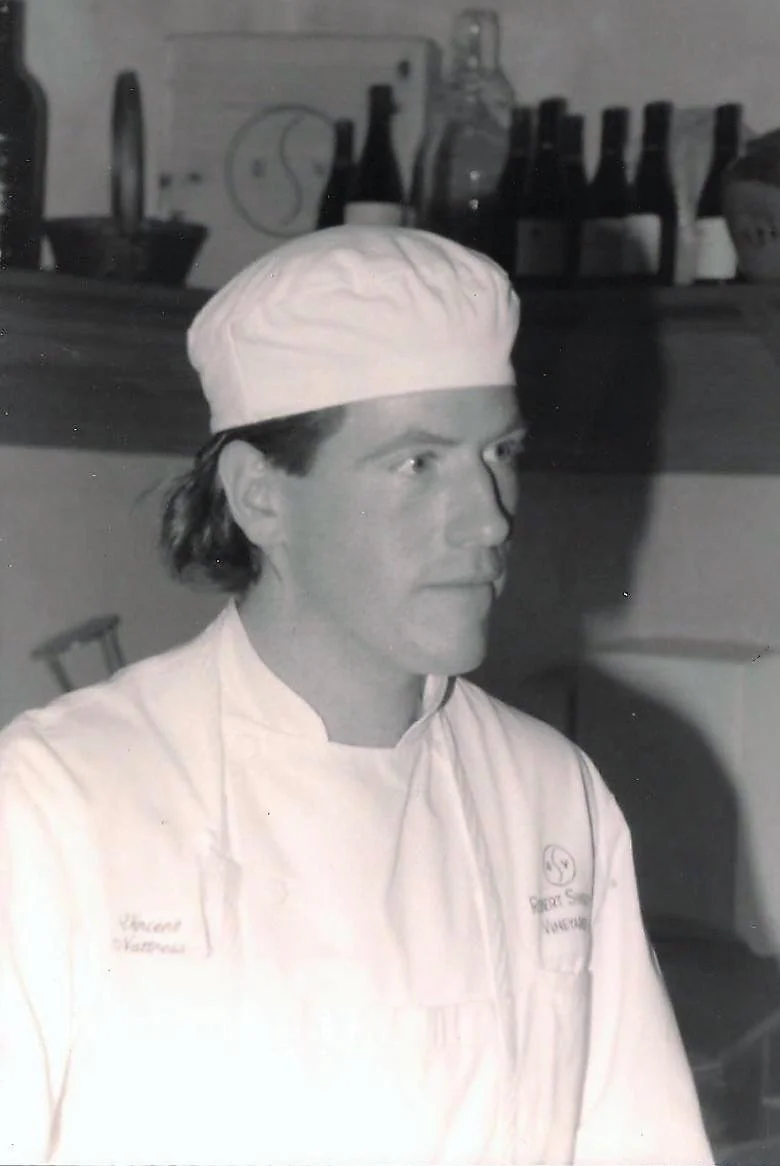
When I was in college I started taking classical guitar. I had always wanted to play an instrument, and this seemed like the perfect time to both fulfill an elective course and learn a new skill. At the same time, I was also learning French and taking that study very seriously. Plus, I had arranged to travel to France to do a quarter of French language study. I hoped my quarter abroad would lead to a chance to cook in France as my senior project. That did in fact pan out, but along the way I had to drop the guitar; I just did not have enough band width to do justice to both a foreign language and a musical instrument.
It occurred to me that learning to cook, learning an instrument and becoming fluent in a foreign language were all very similar. All required a lot of rote memorizations. All require learning manual skills, like fingering cords, how to hold a knife, or how to move your palette to pronounce new sounds. They all rely on many new sensory skills, like tonality, aroma, and tactile learning. Cooking has a syntax, just as languages do, and all must be learned and become muscle memory. You can’t cook if you can’t cut, nor can you speak if you do not know the words and how to pronounce them, and you can’t make music if you don’t know how to properly form the notes.
In all these cases the initial aspects of learning the skill are painfully slow and result in anything but a beautiful experience for the learner. The sounds produced are screechy and atonal, the words nonsense, the food hardly edible. It is not until the syntax and vocabulary are mastered that the student can even mimic the act of speaking or cooking or playing. Finally, and only after the rudimentary aspects of the new skill are so ingrained as to be second nature, only then can anything that approaches originality emerge. It is only then that a speaker of a foreign tongue can go beyond recitation and express ideas in that language that are her own.
It is only then that the musician can go beyond mimicry or playing tunes in a stilted fashion to play with grace, perhaps even exploring melodies that are all his own. Only by working long hours to attain a level of cooking competency can a cook begin to imagine ingredients that they haven’t cooked in real life and accurately imagine what they will taste like together. That is fluency. The ability to think in a new way, be that music, or French, or cooking.
I imagine, though I did not keep track, that Malcolm Gladwell’s 10,000 hours rule applies somewhere in here too. Mastery is a special thing, and I never have attained mastery of the guitar or of the French language. But I have become a master of cooking, and that is pretty cool.
I would disagree with Gladwell in one sense: I think you continue to reach milestones beyond the 10,000-hour threshold, at least I believe I have with my cooking. If I imagine how many hours I have spent with a knife in my hand… it begins to boggle the mind. Conservatively 40 hours X 50 weeks X 42 years. That's 84,000 hours. At my advanced age am a much faster, better, far more intuitive cook than I was at 10 or 20 years ago.
I continue to have insights about things I have cooked for the last 40+ years. I notice differences in products that once would have all looked the same to me. Repetition has not numbed my sensitivity but made my senses more acute. I think my food tastes better than it did 20 or 10 or even 5 years ago. I am more passionate than ever about food, and I continue to learn. A lot.
Cooking has been elevated to an art form, but at our core we cooks are craftsmen. No elevated expression of food in a fine restaurant can be achieved without hours upon hours of repetitive, monotonous practice. The French Chef Alain Passard says that all cooking comes down to what he refers to “les gestes” or the gestures that are so simple, so elegant, so intrinsic to good cooking; how to move a knife though food, how to cover an egg with a perfect napé of hollandaise, how to move a pan or crack an egg.
At first hearing, a fancy French chef telling you that great cooking comes down to gestures sound unbelievably pompous or just ridiculous. But I have spent hours trying to explain to a willing young cook how to ladle soup into a bowl without slopping it all over the rim and their station. Until they learn the gesture necessary, the process is exasperating chaos. Cutting chives correctly takes months to learn. Believe me, despite any delusions to the contrary, you suck at cutting chives. These elemental movements are not innate; they are only acquired through hours and days of repetition and forced correction.
The process of learning these things is what it is to become a cook. Overlaid on these critical mechanical skills is a sensitivity to the nature of the things we are cooking; an attention, not just to smell and taste, but to the sound and the aesthetic of food. Jacques Pepin was the first person who taught me to listen to the chicken roasting in the oven, because when it is done it “sings” as the fat is rendered and sizzling. Eventually I began to sense subtle changes in food I had prepared many times; a brightening of color, a sweet or acrid aroma, the way a piece of fish will release from the pan at the critical point if I had seared it correctly. All of these nuances were completely opaque to the younger me, even several years into the “art” of cooking.
Increasingly I feel that the separation between good and great cooking has most to do with paying attention.
Orchard Kitchen takes that to an entirely different level.