
Partnership & Perspective | From Chef Vincent
by Vincent Nattress (if joining from our Newsletter jump to after the photos.)
Bread has always been important to me. When I first went to France, I began to understand the deep connection bread has to culture. The French, so particular about so much of the art of the eating, will set a loaf directly on the table. It is passed from hand to hand and torn apart with your hands. This seemed completely out of keeping with their otherwise prim table manners, but they told me that bread is intrinsically wholesome. It cannot be dirty; it is the stuff of life. Learning this made me fall more deeply in love with France.
I knew when we opened Orchard Kitchen that we would need good bread. When Little Red Hen Bakery opened in Coupeville I bought their bread, and it jived well with us; they were made from locally sourced wheat. But when they reduced their delivery schedule to one day a week in the fall, which would have left me with two-day-old bread for my guests each Saturday, that was a deal breaker. Our server and assistant manager Sayaka, stepped forward to say that she would be interested in learning how to bake bread. She gave it her best shot for several months, but we were sort of limping along, making some modest improvements on our bread-making, when Sayaka announced that she was going to have a baby and move to Hawaii with her hubby.
Now, the thing I had avoided for 35 years had happened; I was being forced to learn how to bake bread. In the winter of 2018, we had a diner at our Chef’s Counter who took interest in our struggling bread program. I struck up a conversation with her, and she told me she was a baker from the midwest. The conversation turned to her bold assertion that baking great sourdough was not really that hard, that she had a book out and that I could start with that as a foundation. The kicker was her offer to serve as my coach; she gave me her number and told me I was welcome to text her if I had any questions. That baker was Ellen King of Hewn in Evanston, just north of Chicago. Ellen’s excellent, clear, well-written book, Heritage Baking, had just come out in 2018 (I think she might have been here in the Seattle area, where she had long worked, to promote the book, but I’m not sure). Heritage Baking was my first real stepping off point, and I did take Ellen up on the offer to answer my questions via text and phone. With her guidance and encouragement, I dove into sourdough with renewed vigor. The base recipe from Ellen’s book would become the starting point for the bread we bake today at Orchard Kitchen. It is unique to us now only because of the flours we use and the techniques that we have developed in the subsequent years.
I was also incredibly lucky in that during this very same period of 2018 and 2019, I had as part of my staff both Maya Garber Yonts and Zach Fontanes-Halliday. Both had professional baking experience, working for an artisan bakery in Northern California. When Zack came aboard, ostensibly as a waiter, he was eager to jump into the kitchen part time and help elevate our sourdough. When he started at Orchard Kitchen, I believe we were making a very acceptable bread, as the result of Ellen’s book and her long-distance coaching help. Zach was able to show me more of the tactile aspects of how to handle the dough and how to read what it was doing at various points. (cont. below)
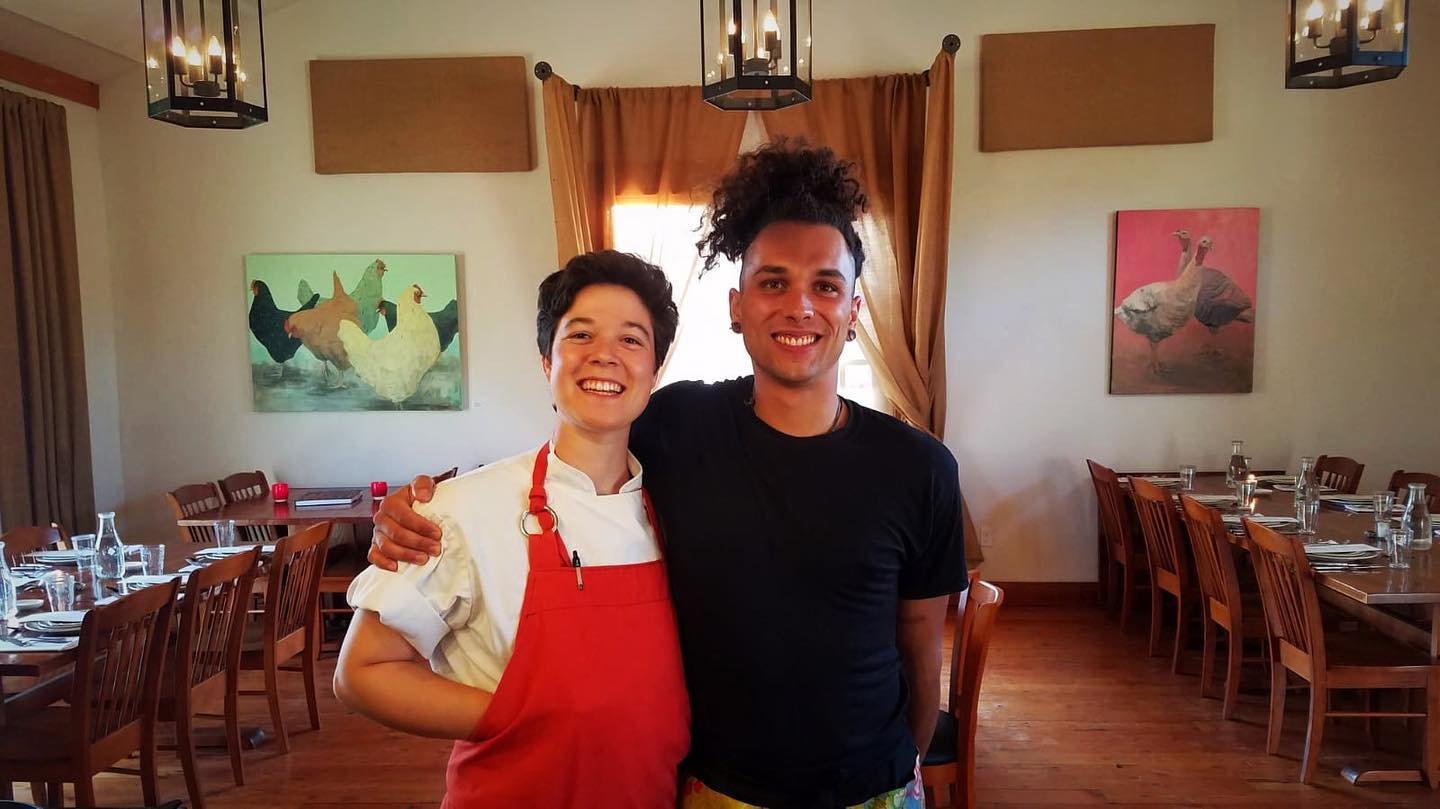
Maya & Zach
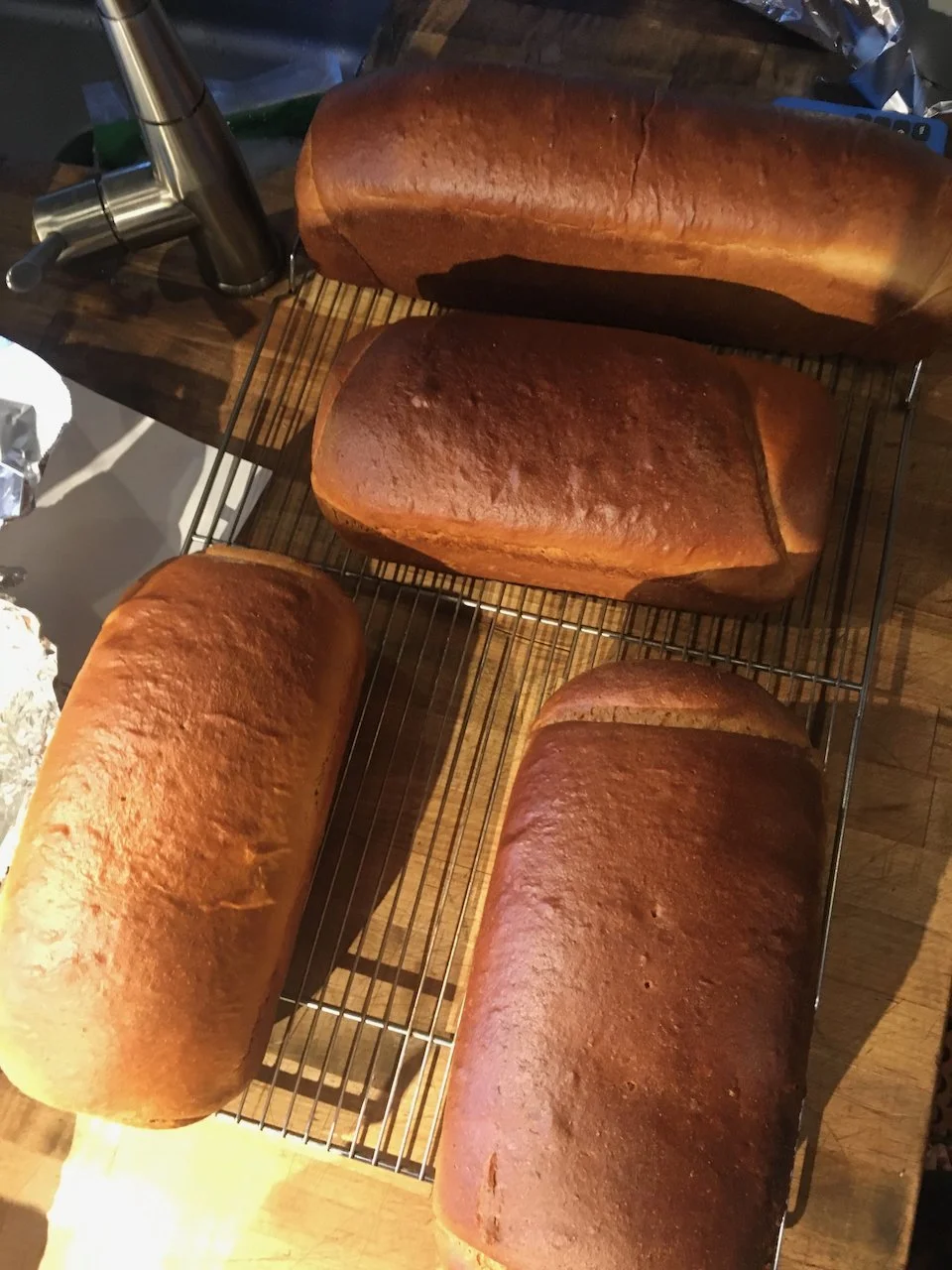
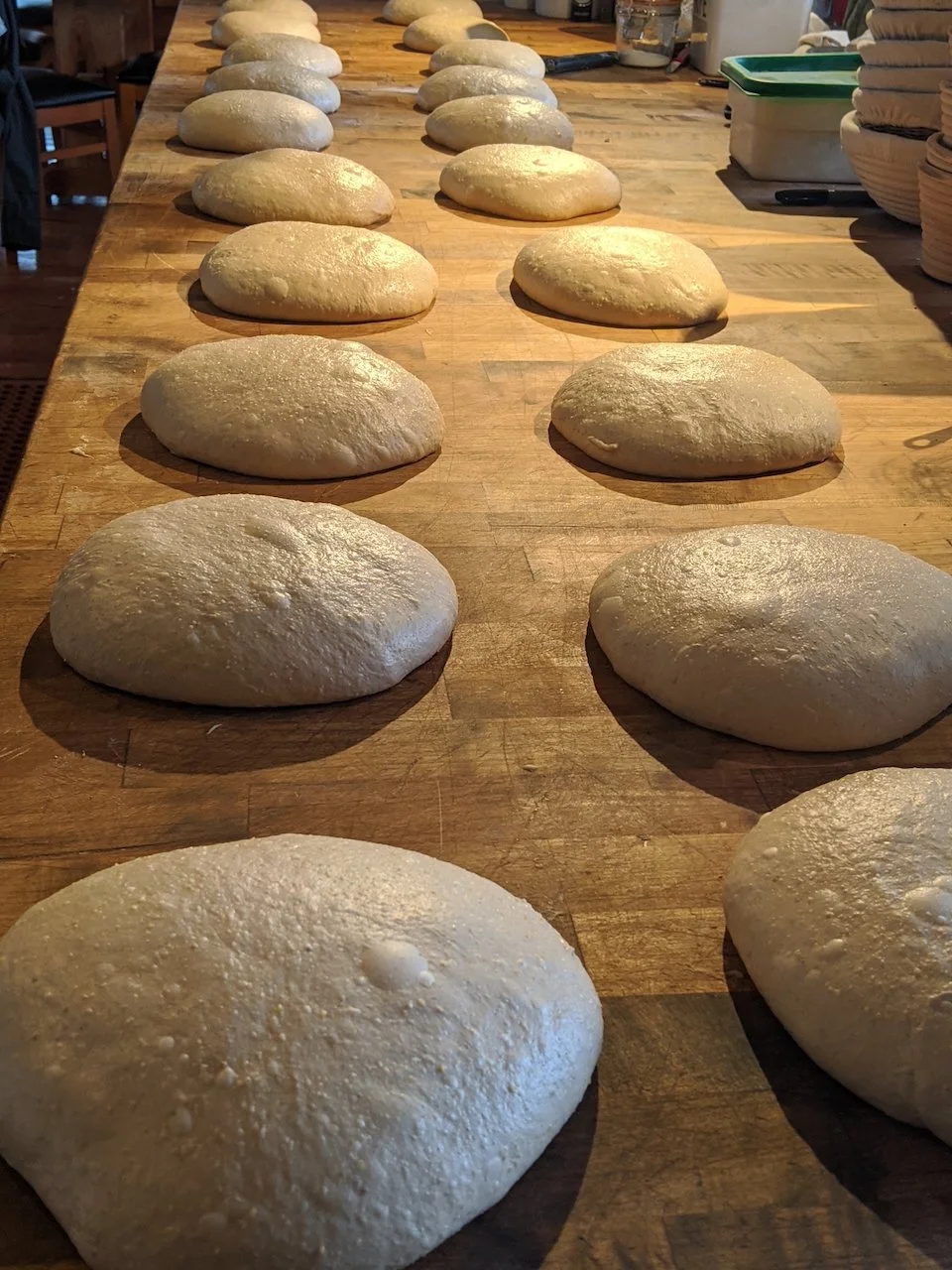
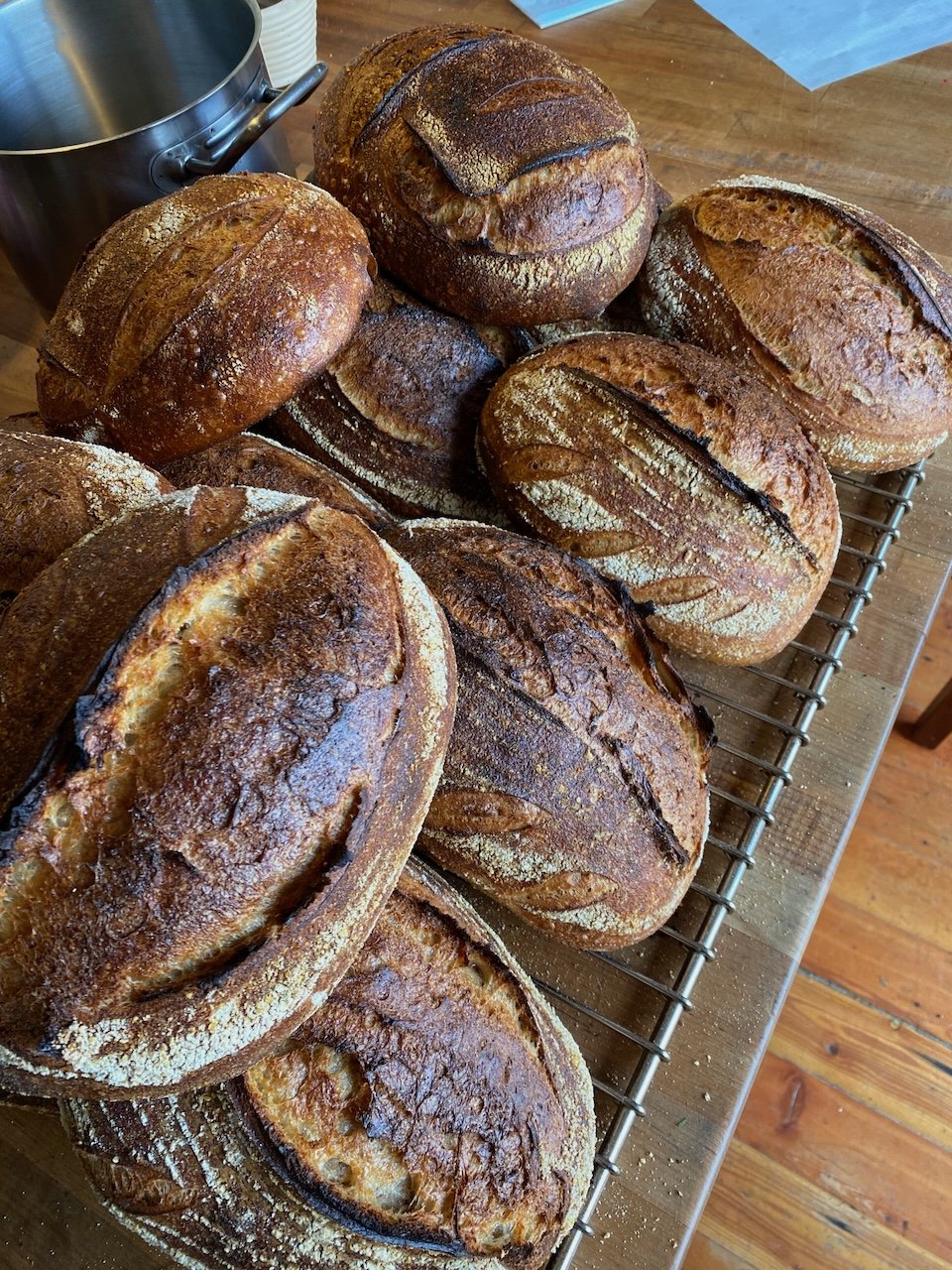
The various stages of my learning.
The handling of the dough is one of the most challenging things for a beginner to master. As a beginning baker, a properly high-hydration sourdough seems impossible to handle; it wants to stick to everything: the bowl, the counter, your hands, your trusty bench knife. It is only by gaining confidence and learning to move with quick, positive, deliberate movements, that the baker can gain control of the dough. For me, the final shaping took a particularly long time to master; I would watch Zack intently and try to follow along, only to have my loaves not pass muster to Zack’s discerning eye. This is another perfect example of the 1,000-iteration test. If you had asked me in the summer of 2019 if I had properly performed the final forming of one of my loaves, I probably would have said yes. But when Zack looked at them, he could see that they were lacking; his eyes were trained to see what to look for and I was essentially blind to it. Once I figured out how to see the difference, that his loaves had crisp, clean, squared-off ends after his final forming, only then could I begin to try and duplicate that shaping. It still took me another several weeks to consistently achieve a loaf that was acceptable to Zack’s standard, but at least I could then see and understand exactly how I was failing. By the time of this writing, my back-of-the-envelope calculation is that I have personally formed well over 5,000 loaves. Now I know.
With Zack’s help, we began to experiment with different additions and different timings, adding a pâte fermentée to the dough, making it much more like an actual pain au levain. This is a little in the weeds, but a true pain au levain is literally a bread made from old bread dough, as opposed to a starter. A starter is closer to a poolish, or wet slurry of starter culture that is usually 50/50 water and flour. Pain au levain starts with a “levain”, or a piece of yesterday’s dough, which can be broken up and watered down to make it more able to integrate into the mixture to start the fermentation. What we began doing at Zack’s instruction was to save back a percentage of yesterday’s bread to put on top of the autolyse (more on that later) before we add the starter. This day-old dough had a lot more flavor because it had over 24 hours to develop. We also played with many aspects of our bread’s composition, including the ratio of whole grain to sifted wheat flours, the hydration rate, choosing a 100% rye flour starter, adding a percentage of buttermilk to the dough, as well as about 4% of our own, house-ground, 8-row Flint cornmeal to the flour mixture.
The other fortuitous situation that we found ourselves in was being located less than an hour away from Cairnspring Mills. Cairnspring is, without exaggeration, one of the best bread flour mills in the world. Kevin Morris, its founder and mastermind, is known to be not only an excellent miller, but someone who builds connections between farmers and bakers. He is a champion for local agriculture. He is a champion for farming of grain for bread in Western Washington, whereas we typically think of wheat coming from the dry, high, arid eastern side of the Cascade Mountain Range. Kevin's understanding of the micro and the macro aspects of wheat farming, milling, and economics has been instrumental in the creation of a new generation of great American bakers. I first realized just how lucky I was the first time I showed up at Cairnspring to pick up my flour, and found towering pallets, stacked high with 50-pound bags of flour, labeled “Tartine Seoul.” Here was 10,000 lbs of flour ready to be sent from Skagit to Korea, for one of the best baking companies in the world. Tartine could literally afford to get their flour anywhere, but they only get it from Kevin. I drive to Skagit several times a year to pick up my humble 400 or 500 lbs. of flour, and I always feel extremely lucky to have them as a resource. Great flour is key to great bread, period. Just as Escoffier said, without great ingredients the chef cannot be held responsible for the quality of his product. Having Cairnspring Mills flour puts all the burden on me; if something's not perfect with my bread, it's not the fault of the flour, it’s my fault.
All these gradual, incremental refinements and changes create a loaf that is unique to us, and of which we are extremely proud. We were a couple of years early to the sourdough renaissance that came as the result of the COVID-19 pandemic. Because of that, when the pandemic happened and we were forced to close our restaurant, our ability to produce truly excellent loaves of sourdough bread for sale was one of the things that kept us afloat. Knowing how to bake sourdough bread is extremely rewarding. During the times we take off from running the restaurant, like the time right now as I write this book, I very much miss the feel of the dough between my fingers. It's an extremely nourishing experience spiritually for the baker to make good bread, to feel the dough in your hands, to smell the ferment as it progresses, to see the transformation of the bulk ferment as it swells and becomes silky and elastic, and to bake the dough into deep chestnut loaves, with a sharp, almost black “ear.”
Now, if you will excuse me for just a minute, I think I need to go start a batch of sourdough…