
From Cook to Restaurant | From Chef Vincent
A "Rouxed" Awakening
by Vincent Nattress
Orchard Kitchen is not the first restaurant Tyla and I have owned. Our first restaurant was called Roux, and it existed on Main Street in St. Helena, right in the middle of Napa Valley from 2001 to 2004. Tyla and I were newly married when I had the brilliant idea of opening a restaurant. It was really something I had always wanted to do, and when I saw the sign for a restaurant space available in my hometown right on Main Street, I was extremely excited at the prospect. That's pretty much where the problems began. (cont. below)
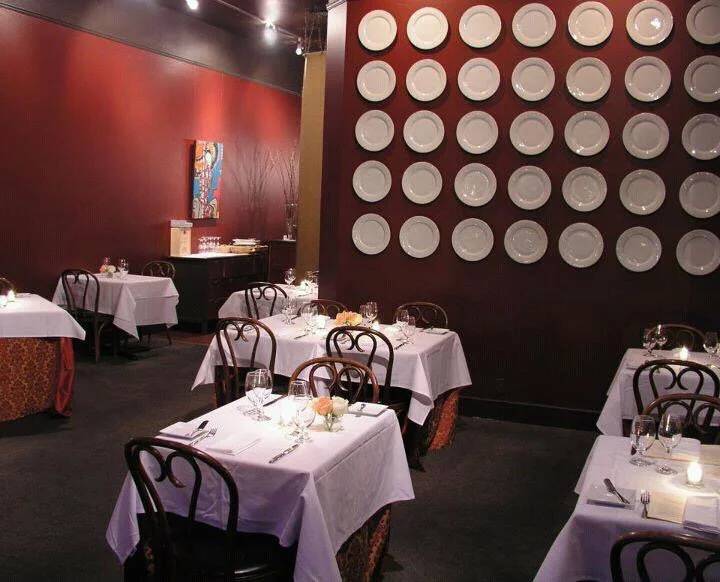
Our dining room remodel happened after the Chronicle came to review us and wrote; "If you're looking for glitz, you'll be disappointed; but if you're looking for soul, Roux is in the thick of it." Roux is a culinary term that means"ia mixture of flour and fat cooked together and used to thicken sauces" but it can also mean "red head" in French.
...Just like Orchard Kitchen, Roux was a tiny space, with the main dining room only seating 32 people if they were arranged cheek to jowl. There was a small bar, but it functioned more as a service station than a true bar, so we rarely seated guests there, aside from the occasional single diner. And there was a small courtyard which, when weather would allow, served as a dining area for an additional 12 or 14 guests. I remember having had a conversation with the great chef Nancy Oakes about the viability of restaurants, and having her say that at the time, around 1999 or 2000, that she didn't think it was possible for a restaurant to be viable if it had less than 75 seats. About the time we were opening Roux I told Nancy about our decision to try and make a go of it with a 44-seat restaurant. She sort of shrugged and said we might be fine, after all we also had our catering business.
I had been catering in Napa for three or four years at that point and had a pretty good clientele. Catering can be quite a bit more profitable than restaurants; you only have to order food for guests you know you're going to serve, as opposed to restaurants where you have to prep a whole menu and try to guess what people are going to order. It was the catering business that led me to Roux, and it was through catering clients that we funded it, that and our money from Tyla’s aunt and uncle.
We had ambitious goals and an ambitious timeline. From the time we put the offer in to purchase the restaurant, to the time we were open with something like five and a half weeks, which is ridiculous, especially considering we jackhammered out the kitchen floor and had a new one poured during that period. It was a crazy sprint to open, based mostly on the fact that we did not have any money, so we had to open as soon as possible.
Almost everything we did was on a shoestring, with a very limited construction budget and our own cash flow to finance the project. But we did spend a little bit of money, about $5,000, to hire a well-known public relations maven, Pam Hunter, who helped us gain some attention, primarily from the San Francisco Chronicle’s food critic, Michael Bauer. This was before Michelin and at a time when success went through this one person's hands.
We opened in May and at some point, in August, I remember being in the kitchen and seeing the phone on the line light up. I looked at the caller ID and it said "Bauer, Michael".
All told, he visited us three times, and we were aware he was there each time. We were sweating bullets when he was dining, and through the period of time the Chronicle had called and sent a photographer to take pictures of the restaurant. We knew we were going to be reviewed soon.
The stress mounted significantly when our neighboring restaurant Cindy's Backstreet Kitchen, run by a well-funded, veteran restauranteur and famous Napa Chef Cyndy Pawlcyn, received their Chronicle review the Sunday immediately before us. That review was brutal. I can remember a couple of the lines from the review to this day; one stating that the rabbit tacos were a “waste of a bunny's life” and the second, that the service staff had “the rhythm of a seasick violinist.” When Tyla read that review, knowing that we were up next for our review, she broke into tears.
To our great relief, the review that we received was incredibly gracious. We received three for food out of a possible four and an overall rating of two and a half stars out of four, which for our tiny, under-budget, out-of-nowhere startup, was great news. Additionally, the narrative part of the article was positive in the extreme. My favorite part was after running through the gamut of dishes on the menu without a single criticism, Bauer concluded this way: “In dish after dish, the chef shows an unwavering restraint and a natural talent for balancing flavors.” I mean, shit, at 33 I was walking on air.
However…
The buzz we were hoping would be created with this lovely infusion of interest from the Chronicle could not have come at a worse time. We received our review on Sunday, September 9, 2001. By Tuesday, 9/11/2001, the entire country was in shock. The country was under attack, all airline travel was suspended, and the economic repercussions would continue to roll out for many months to come. More significantly, with catering as our mainstay of economic success, we lost all our scheduled caterings for the rest of September as well as October and November of 2001; corporate events and private parties just absolutely dried up. The potential boost our fledgling little restaurant might have received from such a great review was completely drowned out by reality.
In addition, the economic reality of having a tiny restaurant with insufferably high rent and insurance costs really hit home. What would have been a big nut to cover each month, a combined $5000 in rent and triple net insurance, became a crushing weight on our little restaurant. We were also just north of Silicon Valley, and in 2001 and 2002 we were slogging through what we now call the Dot Com Bubble, and it was depressing what had been the optimism of the Clinton years.
In the end Roux would make the list of the Chronicle’s Top 10 Restaurants of 2001, and we would remain in the top 100 restaurant list for each of the three years we were open, but the economic realities would never allow us to claw our way to success. Other publications also featured Roux, including Food & Wine, Travel and Leisure, and the Wall Street Journal, among others. In the end Nancy Oakes was, of course, right; 34 seats is not enough to make a go of it. We were never able to capture the full demand we had from our potential clients on a Friday or Saturday night; we turned guests away every weekend night. We heard from many people in the community that they did not dine with us because we were always full. At the same time, we were never once full on a Tuesday night. Our 5 and then 6-night week schedule – which left us exhausted because the “day off” for a restauranteur is actually a planning, cleaning, meeting, and ordering day - left many people saying things like “they are never open.” And the catering never returned to a level that would keep us afloat.
Roux was a great adventure, and I am proud of my first baby. It was a critical success, and a financial disaster. Tyla and I ended up filing for personal bankruptcy, with a 3-month-old daughter to care for. Our partners, the Winiarski’s of Stag’s Leap Wine Cellars, George Vare of Luna, and Tyla’s aunt and uncle all lost five-figure amounts, and to their credit, were all very supportive of our business failing. George Vare met with us as we were deciding if we needed to close, and he told us how he had been through bankruptcy himself and how he had gotten through it and found success on the other side. He was instrumental in allowing us to make the right decision and move forward.
If you think you can learn a lot from running a successful restaurant, I am here to tell you that you can learn a great deal from having one fail. Tyla’s uncle Eddie used the phrase more than once in the run up to opening Roux: measure twice, cut once. That mindset is correct, but more importantly is the idea of understanding what it is you are measuring and realizing that you don’t just cut to fit, you cut to have enough extra to not have any gaps.